

As the popularity of startups continues to rise, so too does the demand of platforms for startup crowdfunding. Crowdfunding has become a powerful avenue for startups to raise capital, enabling investors to participate in early-stage businesses with promising growth potential. With a variety of platforms available, each catering to different types of investors and businesses, choosing the right one can be challenging. This guide provides a comprehensive look at the top 10 platforms for startup crowdfunding, covering features, benefits, and potential risks associated with each. Whether you’re just starting out or already know the ropes, this guide will help you pick a platform that fits your goals and how much risk you’re cool with.
Comparison of TOP 10 Platforms for Startup Crowdfunding
| Platform | Rating | Loan Types | Total Active Portfolio | Stages | Review |
|---|---|---|---|---|---|
| Crowdcube | ★★★☆☆ | Equity investments, mini-bonds | £8.6M | Early stage, Seed, Growth | Read review |
| Seedmatch | ★★★☆☆ | Equity and debt-based investments | €78M | Seed, Growth | Read review |
| Companisto | ★★★★☆ | Equity and debt-based investments | €206M | Seed, Growth | Read review |
| Scramble | ★★★★☆ | Debt-based investments | €8.3M | Seed, Growth | Read review |
| Republic Europe | ★★★★☆ | Equity and debt-based investments | £2.9B | Pre-Seed, Seed, Series A, Series B and Beyond | Read review |
| Sowefund | ★★★☆☆ | Equity, convertible bonds | €100M+ | Pre-Seed, Seed, Series A, Series B and Beyond | Read review |
| Angels Den | ★★★☆☆ | Equity and debt-based investments | £2.5B+ | Seed, Growth, Late | Read review |
| CrowdAboutNow | ★★☆☆☆ | Debt-based investments | €112M | Seed, Growth | Read review |
| NPEX | ★★★★☆ | Equity and debt-based investments | €192M | Early stage, Seed, Growth | Read review |
| Crowdberry | ★★★★☆ | Equity and debt-based investments | €60M | Early stage, Seed, Growth | Read review |
Leading Platforms for Startups Crowdfunding
Crowdcube
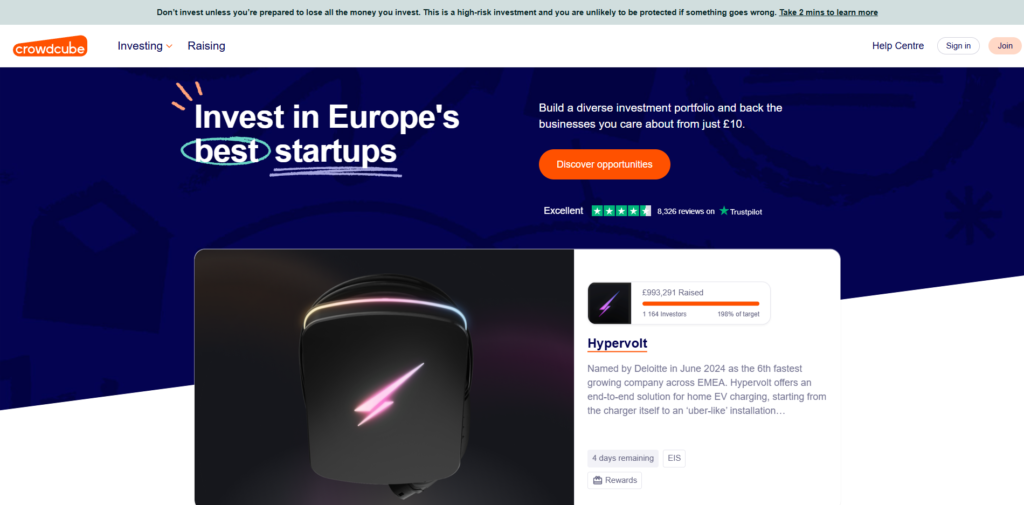
Crowdcube is authorized and regulated by the FCA in the UK, providing a level of oversight and investor protection. However, this does not eliminate the inherent risks associated with equity crowdfunding. Certain investments may qualify for tax reliefs, such as the EIS or SEIS.
| Pros | Cons |
|---|---|
| Easy to use. | Confusing issues with the verification process, document uploading problems. |
| Investments starting from as low as £10. | The platform’s fees, especially recent increases. |
| A variety of startups across sectors. | No secondary market. |
| Clear information is provided about exit options. | Response times from support were occasionally slow. |
| Provides ample guidance for new investors. | High failure rates and risk of dilution. |
Seedmatch
| Pros | Cons |
|---|---|
| Detailed financial information | High risk of investment loss |
| Tax deduction opportunities | Delayed document processing |
| Intuitive platform layout | Limited liquidity: lack of a secondary market |
| One of the first crowdfinancing platforms in Germany | Risk of insolvency and non-disclosure: several companies failed post-funding (betandsleep, BluePatent, foodieSquare etc) |
| Educational resources | Delayed or withheld dividends, and changes in expected returns without clear communication. |
Companisto
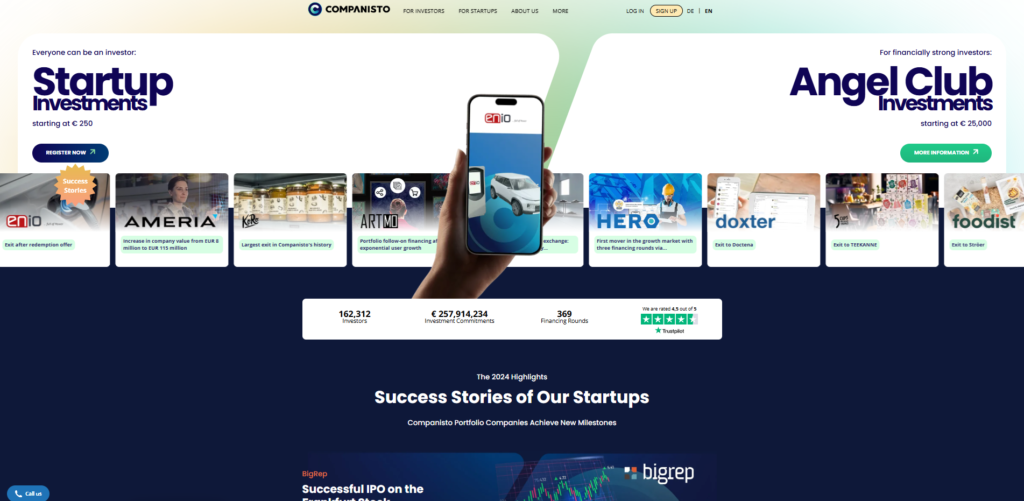
For those who are adept at navigating the complexities of early-stage investments, Companisto can be a valuable tool for accessing unique and high-potential opportunities within the European market. However, try to approach the platform with a critical eye and a readiness to actively manage their involvement, ensuring they are comfortable with both the high risks and the potentially high rewards that come with investing on P2P platforms in early-stage ventures.
Companisto offers a secondary market that allows investors to buy and sell shares in startups outside of active funding rounds. It’s important to note that trading may be suspended during certain events, such as follow-on financing rounds or exits. To assist with this, Companisto provides a range of data points and company profiles on each listed opportunity. Information typically includes business models, financials, market assessments, and founder backgrounds. As with many equity crowdfunding platforms, there may be some variability in the level of detail across listings, and you may find value in conducting additional research or engaging directly with the startups for further insights.
| Pros | Cons |
|---|---|
| Companies for crowdfunding are carefully selected. | Limited accessibility for non-German speakers. |
| Structured and detailed information for each startup. | Issues with identification process for non-European ID holders. |
| User-friendly platform with easy onboarding process. | High-risk investments with frequent company failures reported. |
| Secondary market available for buying and selling shares | Limited liquidity despite the secondary market, with trading suspensions |
| Fast updates on payments and investments. | Some reports of companies failing soon after receiving investments. |
| Investor community feature for networking and knowledge sharing. | Slow process for share allocation. |
Scramble

Scramble distinguishes itself by concentrating on high-growth European consumer goods brands, particularly those committed to sustainability, eco-friendliness, and ethical practices. The brands featured on Scramble often align with emerging consumer trends like organic and cruelty-free products. One of Scramble’s most appealing aspects is its monthly investment rounds. This approach to investment opportunities provides regular access to a curated selection of brand.
A core feature of Scramble is its loan structure, divided into two distinct groups based on risk and security levels. Group A is designed for investors with a lower tolerance for risk and offers an annual return of up to 12.4%, secured by co-founder guarantees and a first-loss capital guarantee. These security measures provide additional protection, mitigating the risk of default and offering some assurance that invested capital is safeguarded. Group B, on the other hand, caters to higher-risk investors seeking potentially greater returns. Although it lacks the same security features as Group A, this group attracts investors who are willing to tolerate higher risk in exchange for the chance of larger financial gains. The dual structure reflects Scramble’s commitment to serving a diverse investor base, allowing individuals to select options aligned with their financial goals and risk profiles.
To enhance investor confidence, Scramble places a significant emphasis on transparency and investor protection. The platform incorporates several measures to protect data privacy, including advanced encryption to secure personal and financial information. Additionally, Scramble’s team actively curates brands for investment, thoroughly evaluating each company’s business model, growth potential, and ethical practices before listing them on the platform.
| Pros | Cons |
|---|---|
| Responsive and helpful customer support with live chat options. | Limited slots in Group B due to high demand, frustrating some early investors. |
| Clear distinction between Group A and Group B for different risk levels. | Confusion around bonuses and restrictions on immediate withdrawals. |
| Transparency in investment information with detailed brand and project insights. | Platform relatively new, leading to concerns about long-term stability. |
| Simple onboarding process, quick account verification and funding. | Risk associated with high-interest loans and limited history of loan performance. |
| Platform promotes ethical and sustainable brands. | Issues with the fund withdrawal process for international users. |
| High repayment rate for Group A loans. | Increased competition among investors, making it difficult to secure investments in high-demand rounds. |
Republic Europe
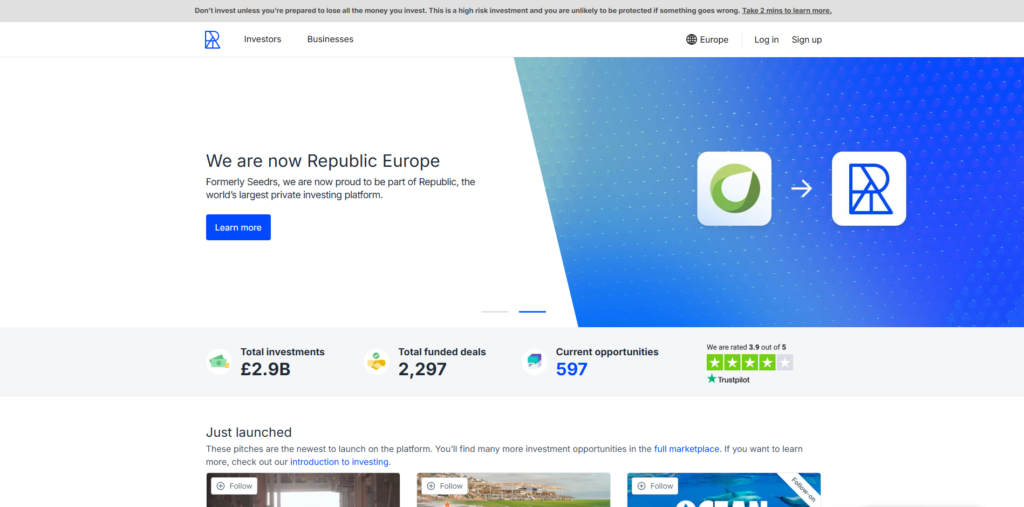
Republic Europe, formerly known as Seedrs, is an equity crowdfunding platform that enables individuals to invest in early-stage and growth businesses across Europe. In July 2024, Seedrs rebranded as Republic Europe following its acquisition by Republic, a U.S.-based investment platform. Despite the name change, Republic Europe continues to operate under the regulatory framework of the FCA in the UK, maintaining its commitment to investor protection and compliance. The platform now offers a more diverse array of investment opportunities, including access to U.S. markets.
Republic Europe employs a nominee structure, where the platform holds shares on behalf of investors. This arrangement simplifies the management of shareholder rights and communications between the company and its investors. The platform also conducts due diligence on businesses seeking funding to ensure that the information presented is fair, clear, and not misleading.
The platform offers a diverse range of investment opportunities, spanning various sectors such as technology, healthcare, and consumer goods. This variety allows to build a diversified portfolio aligned with your interests and risk tolerance. Additionally, Republic Europe provides access to Limited Partner (LP) funds with low minimum investment thresholds, enabling broader participation in venture capital opportunities.
| Pros | Cons |
|---|---|
| The platform is generally user-friendly and straightforward for investments. | Fees are high, including a transaction fee and a 7.5% carry fee. |
| SEIS/EIS tax benefits available on many UK-based investments. | Limited liquidity in the secondary market with occasional slow updates. |
| Active community support, with follow-up after troubleshooting. | Slow fund withdrawal, especially for international accounts. |
| Includes a cooling-off period for investor decisions. | The verification process complex, requiring multiple attempts. |
| Extensive resources and guidance are available. | Issues with fund transfers, leading to delayed investments. |
| Offers access to a wide range of startups and early-stage businesses. | Navigation and finding specific investments is challenging. |
| Nominee structure, which simplifies shareholding. | Decrease in platform reliability and quality after the Republic takeover. |
| Comprehensive investment information, risk warnings, and detailed guides. |
Sowefund
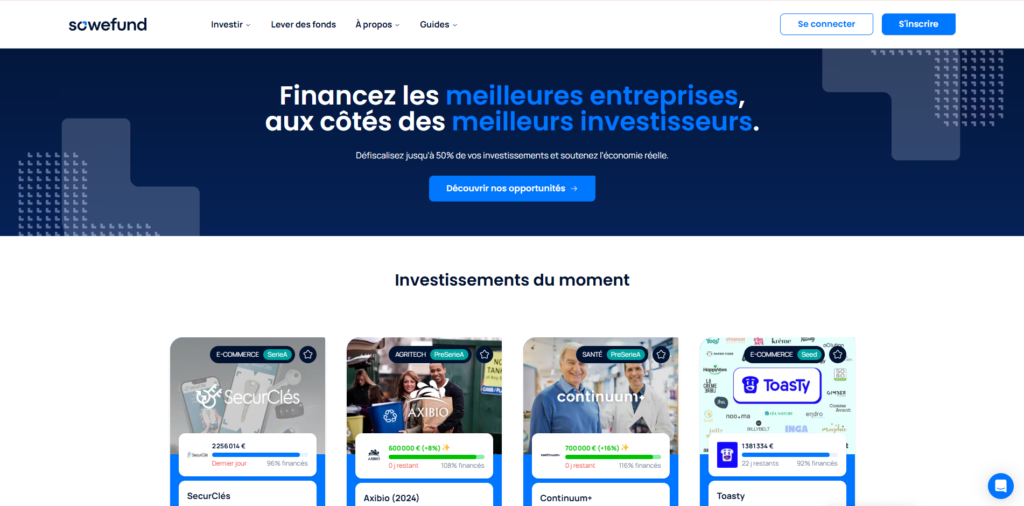
Sowefund is a French equity crowdfunding platform established in 2014, specializing in venture capital investments. It enables individual investors to co-invest alongside professional funds in innovative startups, thereby democratizing access to venture capital and supporting innovation. The platform offers a user-friendly interface, allowing investments starting from €100, making it accessible to a broad audience. Investors can benefit from tax reductions ranging from 18% to 25% on their income tax, enhancing the attractiveness of their investments. Sowefund has facilitated over 100 crowdfunding campaigns since its inception, supporting numerous startups in their fundraising efforts. In 2023, the platform was acquired by the French venture capital firm Founders Future, aiming to enhance its professionalism and solidify its position as a leading co-investment platform.
A prominent theme across user experiences is Sowefund’s high level of customer service. The platform’s team is dedicated, responsive, and available to help address questions or concerns. The platform has also garnered attention for the quality and variety of the projects it offers. The companies listed are carefully vetted, presenting investors with opportunities that are not only promising but also diverse in scope.
In France, certain investments in startups and SMEs qualify for tax reductions, such as the “IR-PME” scheme, which allows for a reduction in income tax based on the amount invested. Additionally, the “JEI” (Jeune Entreprise Innovante) and “JEIR” (Jeune Entreprise Innovante et de Recherche) statuses offer further tax incentives for investments in young, innovative companies. However, there is no clarity and sufficiency of information provided regarding these tax benefits. For instance, there is a lack of transparency concerning the eligibility of certain investments for tax deductions, particularly distinguishing between investments in shares and bonds. Sowefund did not clearly specify whether an investment pertained to shares or bonds, which impacted the investor’s ability to benefit from tax deductions.
Sowefund has taken steps to improve the clarity of information provided to investors. The platform offers guides and resources to help investors understand the tax benefits associated with different types of investments. For example, their “Guide de la défiscalisation – Edition 2024” provides detailed insights into tax reduction opportunities linked to investments in French startups and SMEs.
| Pros | Cons |
|---|---|
| User-friendly platform. | Limited information on defiscalisation. |
| The variety and quality of startups available. | There have been cases where investments were cancelled due to unsatisfactory experiences during the decision-making process. |
| Professional due diligence. | As with any investment in startups, there is an inherent risk of losing the invested capital. |
| Diverse and high-quality projects. | Insufficient information regarding tax benefits associated with certain investments. |
Angels Den
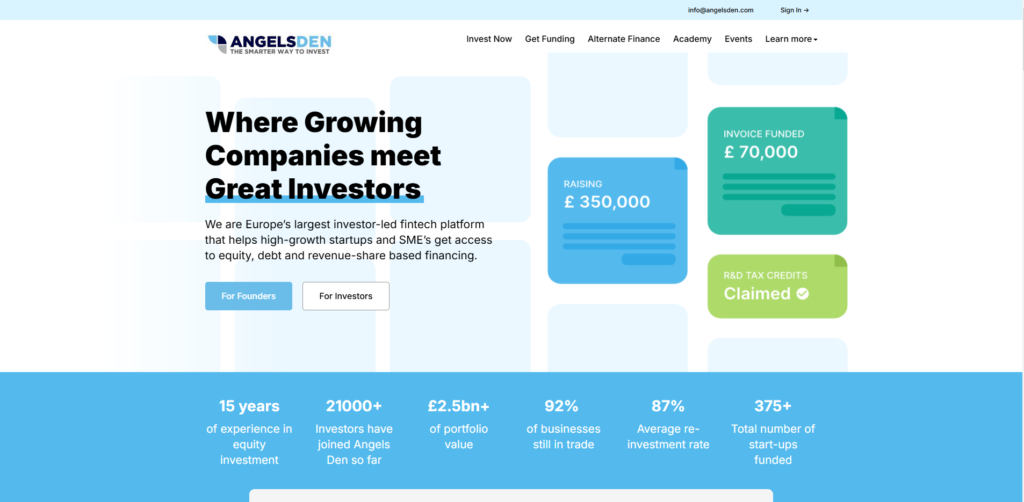
Angels Den is a UK-based investment platform that connects early-stage businesses with angel investors. It has become one of Europe’s largest angel-led finance platforms, facilitating equity and debt financing for startups and SMEs. The platform provides investors with opportunities to invest in carefully selected startups, boasting a network of over 21,000 high-net-worth individuals. Angels Den reports that 92% of its funded companies since 2013 are still active. This high survival rate is significant, especially when compared to general startup statistics. In the context of angel investing, where failure rates are typically high—often cited as around 50-75% within the first few years. However, it’s important to interpret this number critically. While the survival rate is an indicator of business continuity, it does not equate to profitable exits or guarantee returns for investors. Startups can remain active for years without generating significant returns or achieving growth that benefits shareholders. The high activity rate doesn’t reflect the performance in terms of return on investment, nor does it provide insights into liquidity events such as acquisitions, mergers, or IPOs, which are the typical exit strategies for investors.
Another consideration is the platform’s fee structure. Once your pitch is accepted for fundraising, Angels Den charges a one-time onboarding fee of £349 plus VAT. Upon successfully raising funds through the platform, a success fee of 8.5% of the total investment amount is applied. This fee is payable in tranches as funds are received from investors. Angels Den does not charge performance or management fees, and all payments are settled directly between entrepreneurs and investors, eliminating payment processing fees.
| Pros | Cons |
|---|---|
| Businesses are supported by Angels Den’s network. | Lack of secondary market. |
| Extensive vetting of startups before listing. | Startup’s reporting can vary in frequency and depth. |
| Straightforward fees without hidden charges. | 8.5% success fee. |
| Regular updates from the startups. |
CrowdAboutNow
This is a Dutch crowdfunding platform that facilitates financing for SMEs through loans, equity, and pre-sales campaigns. Primarily targets Dutch entrepreneurs and investors, fostering local business growth. The average loan campaign on CrowdAboutNow raises approximately €70,000, with repayment terms typically spanning three to four years. As with all investments, there are risks involved. For loan campaigns, the primary risk is the potential default by the borrowing company. In equity campaigns, the risk lies in the company’s performance, which may affect the value of the investment. Pre-sales campaigns carry the risk of product delays or changes.
The platform emphasizes community engagement, encouraging entrepreneurs to leverage their personal networks to secure funding. This approach often results in a significant portion of investments originating from the entrepreneur’s immediate circle. CrowdAboutNow offers opportunities to support local businesses with investments starting as low as €10. The platform’s focus is more on community involvement than on high financial returns. Interest rates are intentionally kept low, reflecting the platform’s mission to prioritize entrepreneurial support over investor profit.
| Pros | Cons |
|---|---|
| Does not perform credit checks. | Lack of borrower vetting, high risk of borrower defaults, and alleged trend of frequent failures. |
| Diverse funding options: loans, equity investments, and pre-sales campaigns. | High risk of loss, unmet borrower promises. |
| Assists businesses in marketing and campaign management. | Limited investor repeat engagement, as approximately 25% of investors participate in multiple campaigns. |
| Builds a community of investors who are often customers. | Offers lower interest rates and discourages financial perks. |
| Emphasizes projects with positive environmental and social impacts. | Prioritizes the gunfactor over financial incentives. |
NPEX
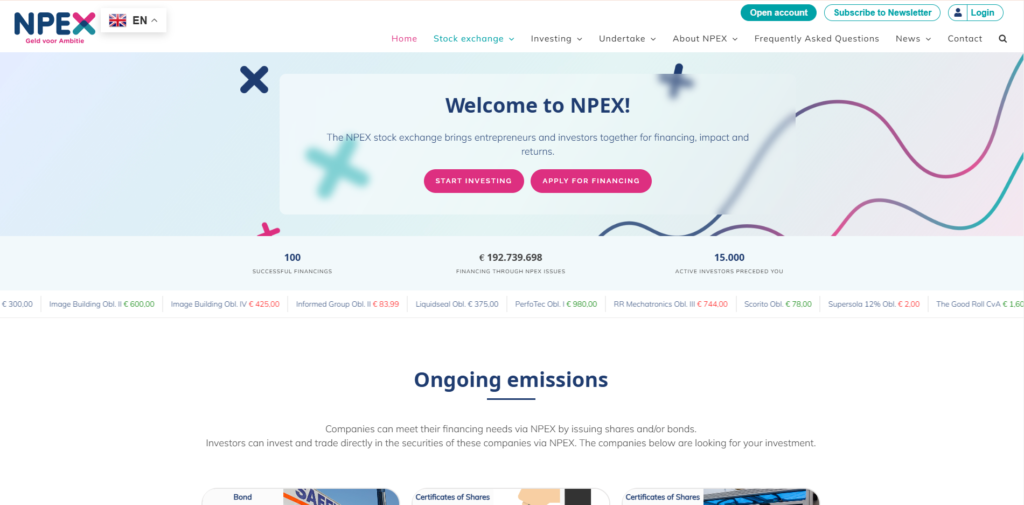
Additionally, investing in SMEs through NPEX allows investors to support entrepreneurial ventures and innovation within the Netherlands. NPEX operates under a Multilateral Trading Facility (MTF) license from the Netherlands Authority for the Financial Markets (AFM) and is under continuous supervision by both the AFM and De Nederlandsche Bank (DNB).
| Pros | Cons |
|---|---|
| Access to SME Investments. | Investments in SMEs carry a higher risk compared to larger, established companies. |
| A range of investment types, including shares and bonds. | The secondary market on NPEX has limited activity. |
| No charges for opening an account and specified fees for transactions and services. | Insufficient information regarding tax benefits associated with certain investments. |
| For bond investments, there’s a risk that the issuing company might default on its interest or principal payments |
Crowdberry
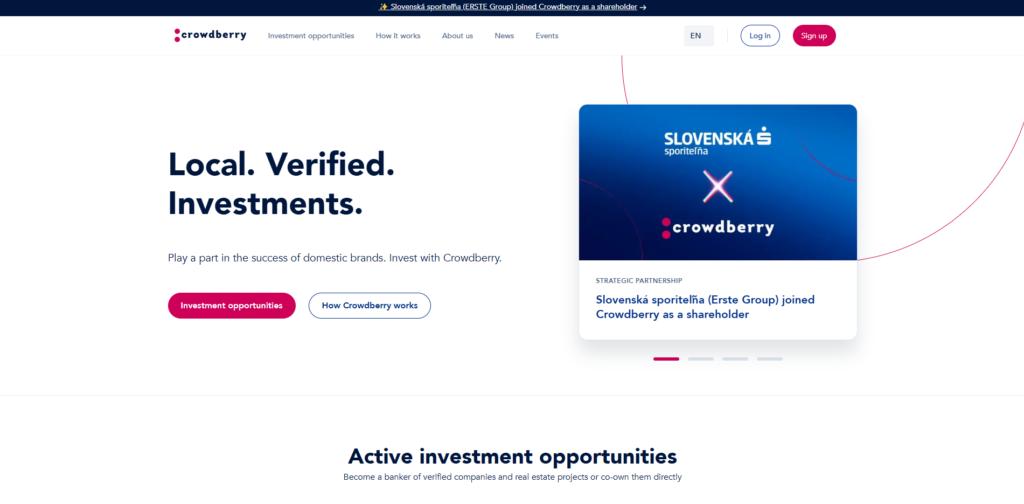
Crowdberry is a licensed investment platform based in Slovakia that enables private investors to directly invest in specific companies and real estate projects, primarily within the Czech Republic and Slovakia. Established in 2015, the platform has facilitated over €65 million in investments across more than 40 companies, contributing to the growth of local businesses and the domestic economy.
Crowdberry offers a diverse range of investment opportunities, including startups, SMEs, and real estate projects. Investments typically range from €0.1 million to €5 million, with the platform managing assets exceeding €100 million.
You can choose from various sectors such as sustainability, health and science, social causes, education, and sports. The platform operates on an equity investment model, allowing users to become co-owners of the companies or projects they support. Crowdberry charges 12% of the net return (after deducting the original investment) for managing the SPV. Registration and use of the Crowdberry platform are free of charge.
| Pros | Cons |
|---|---|
| The platform conducts evaluations of potential investments, assessing financial health, team quality, business strategy, and market potential. | Charges a 12% fee on the net return of successful investments. |
| Various segments, including young companies, SMEs, and real estate, each with different risk-return profiles. | Investments in private companies and real estate can be illiquid. |
| Active post-investment support | The platform requires a minimum investment of €5,000, which might be a barrier. |
| Detailed and transparent investment documentation. | |
| No entry or exit fees. |
Conclusion
Investing in startups requires a tolerance for risk, given the high rate of failure in the sector. A diversified approach across sectors and platforms, combined with a strong understanding of each platform’s due diligence process.
Each of the five platforms discussed offers distinct advantages depending on the investor’s priorities and risk appetite.
- Crowdcube: Offers low-entry investment options and broad sector access but lacks a secondary market for liquidity.
- Seedmatch: Provides in-depth financial data and tax incentives but has limited liquidity and carries high risks with potential delays.
- Companisto: Features a secondary market for added liquidity and community engagement but has restricted accessibility for non-German speakers and high risks.
- Scramble: Focuses on sustainable brands with structured risk options but is relatively new, with limited withdrawal options for international users.
- Republic Europe: Diverse opportunities with U.S. market access and SEIS/EIS tax benefits, though fees are high and liquidity can be limited.
- Sowefund: User-friendly with tax incentives for French investors, but lacks comprehensive clarity on tax benefits and carries startup-related risks.
- Angels Den: High startup survival rate and clear fee structure but lacks a secondary market, which limits liquidity.
- CrowdAboutNow: Supports Dutch SMEs with low interest rates for community support but has high risks due to minimal borrower vetting.
- NPEX: Access to SME shares and bonds in the Netherlands with low fees, though it has limited secondary market activity and higher risks.
- Crowdberry: Offers varied investments and transparent documentation in Central Europe, but high minimum investment and potential illiquidity can be a barrier.
Understanding the pros and cons of each platform and aligning them with your investment objectives, risk appetite, and geographical preferences can help you make the most of your investment journey. While these platforms offer exciting opportunities, they also come with inherent risks, especially in the startup world where success rates can vary widely. Taking a balanced and diversified approach can mitigate some risks from passive income while allowing you to support businesses on their growth journey.
Related Articles

Investing in Startups: How to Identify the Next Big EU Unicorn

What are the Most Successful EU Startups Each Year from 2015 to 2024?

FAQ
Is crowdfunding passive income?
Yes, but not in the traditional sense of passive income. Crowdfunding can provide occasional income, but it’s not typically steady or guaranteed. Returns depend on the success of the startup, which means they can be irregular and may only come after a profitable exit, such as a buyout or IPO. Some crowdfunding platforms offer revenue-sharing models where you might receive a portion of profits, but these payments aren't consistent. So while it may generate income occasionally, crowdfunding is considered a high-risk investment rather than a regular passive income source.
What is Crowdcube, and what are its key features?
Crowdcube is an equity crowdfunding platform that allows investors to acquire shares in early-stage and growth-focused businesses across various sectors. Investments can start from as little as £10. However, it lacks a secondary market, meaning investments are typically illiquid and may require holding for several years until an exit opportunity arises. The platform is authorized and regulated by the UK's Financial Conduct Authority (FCA).
How does Seedmatch support investors in evaluating startups?
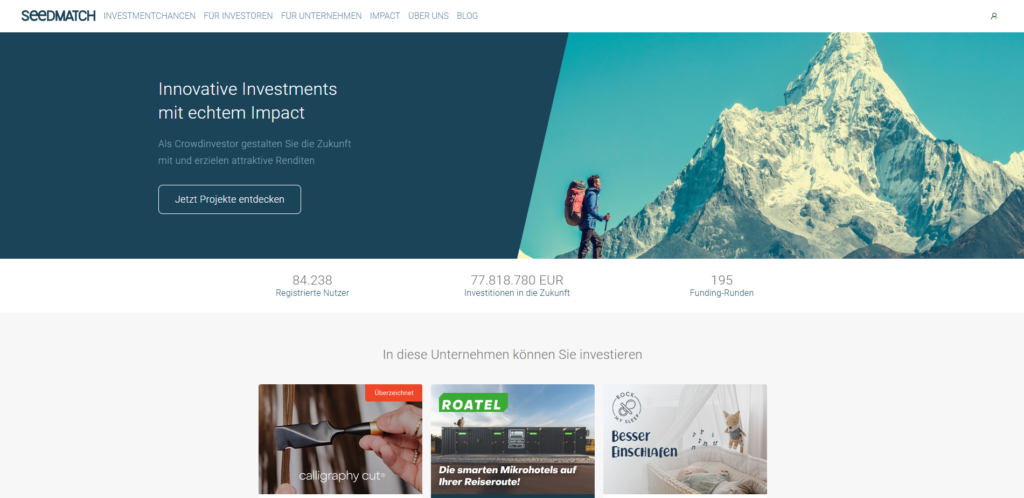
Seedmatch, a German crowdfunding platform, provides investors with business plans, financials, and question-and-answer sessions to thoroughly evaluate investment opportunities. Additionally, the Seedmatch Academy offers a free educational program designed to familiarize individuals with the fundamentals of crowdfinancing and investments in startups. The platform does not charge fees to investors; its revenue is generated through success fees charged to companies upon successful funding.
What distinguishes Companisto’s investment approach?
Companisto offers a steady flow of investment opportunities, primarily in technology, healthcare, and consumer sectors, featuring companies at different development stages. It provides a secondary market that allows investors to buy and sell shares in startups outside of active funding rounds, though trading may be suspended during certain events. The platform fosters an active investor community through its online platform, enabling members to engage in discussions, share insights, and collaborate on investment opportunities.
How does Scramble cater to different investor risk profiles?
Scramble focuses on high-growth European consumer goods brands committed to sustainability and ethical practices. It offers two investment groups: Group A, designed for investors with a lower risk tolerance, offers an annual return of up to 12.4%, secured by co-founder guarantees and a first-loss capital guarantee. Group B caters to higher-risk investors seeking potentially greater returns but lacks the security features of Group A. This dual structure allows investors to select options aligned with their financial goals and risk profiles.
How does Sowefund support investor education and tax benefits?
Sowefund, a French equity crowdfunding platform, offers a user-friendly interface with investments starting from €100. It provides guides and resources to help investors understand the tax benefits associated with different types of investments, such as the "IR-PME" scheme, which allows for a reduction in income tax based on the amount invested. The platform has facilitated over 100 crowdfunding campaigns since its inception, supporting numerous startups in their fundraising efforts.